Key takeaways
- Vent count, number of systems, and attic or crawlspace access drive the price far more than square footage.
- A real cleaning uses negative air with brush or whip agitation on every supply and return run and takes most homes 2 to 4 hours.
- Skip sanitizing and other add-ons unless there's a specific reason like water damage, smoke residue, or a dirty coil.
Air duct cleaning cost in San Diego depends mostly on the number of vents, the number and size of HVAC systems, how hard the ducts are to reach, and how dirty or damaged they are. In our experience a legitimate job takes a crew a few hours with negative air equipment, so be wary of a quote that covers a whole house for almost nothing. Compare quotes by what's included, not by the bottom-line number.
How much does air duct cleaning cost in San Diego?
ODK Services publishes this post, and we do duct cleaning, so weigh what follows accordingly. We don't list a flat price because two 1,800-square-foot houses can be completely different jobs. One has a single system, 10 supply registers, one big return, and a walk-in attic. The other has two systems, 22 openings, a hatch the size of a shoebox, and ducts buried under a foot of blown insulation. Same square footage, very different day for the crew.
We're also not going to print dollar figures. Anything we put here would be wrong for half the houses that read it. What you can expect is how a quote should scale:
- A one-system home with a modest vent count should land at the low end of any company's range.
- A two- or three-system home should cost clearly more, not the same price with a "large home" surcharge. Each system is its own setup.
- Hard access, heavy contamination, and add-ons move the price on top of that.
- Most companies price as a base per system plus a per-vent amount, or by tiers. Ask which one they use and get it itemized.
The drivers, roughly in order of how much they move the number:
- Vent count. Every supply and return opening is its own run.
- Number of systems. Each has its own air handler, plenum, and trunk lines.
- Access. Attic, crawlspace, closet, garage, or rooftop unit.
- Condition. Light dust versus construction debris, pest nesting, or smoke residue.
- Add-ons. Dryer vent cleaning, coil cleaning, sanitizing, repairs.
A quote based only on square footage means nobody asked the questions that decide how long the job takes. Expect the same quick routine no matter what your house needs.
Get these in writing: the number of supply registers and return grilles, the number of systems, whether trunk lines, plenums, and the blower compartment are included, and what each extra covers.
On time: from our own jobs, a single-system house with a dozen or so vents usually takes a crew a few hours. Two or more systems or tough access can take most of a day. The price has to cover the crew, the truck, the fuel, and the equipment. If a quote is far below that math, something is getting skipped.
Why number of vents and system size change the price
Every supply register and return grille is a run that has to be opened, agitated, and vacuumed. We don't clean "the ducts" as one thing. We feed an air whip or rotary brush down each run while the vacuum pulls the loosened dust out. Ten runs and twenty-five runs are not the same amount of labor.
Picture a single-story ranch in Clairemont with one furnace in the hall closet or garage. Short runs, one system, usually manageable. Now picture a two-story in Otay Ranch, or a newer North County build with two or three systems: one in the attic serving upstairs, another in the garage serving downstairs. Each system gets its own setup, its own vacuum connection, and its own trunk and plenum work. That's close to doing two or three houses in one visit.
Larger trunk lines and plenums take longer. Sometimes we have to make a small access cut in the sheet metal to get the hose or brush in. A proper cut gets sealed and patched afterward, so ask whether that's included.
Returns deserve their own question. They pull air from the living space, so they're often the dirtiest part of the system: pet hair, lint, drywall dust. Some quotes count only the supplies, or clean the return grille and filter slot without going up the return duct. Ask directly: "Are the returns counted and cleaned?"
Dryer vents and bathroom exhaust fans aren't part of your HVAC. Dryer vent cleaning is a separate job with different tools and should be its own line on the quote. It's often worth doing, especially on long runs that exit through the roof, but it shouldn't hide inside a vague "whole house" price.
What does negative air have to do with the price?
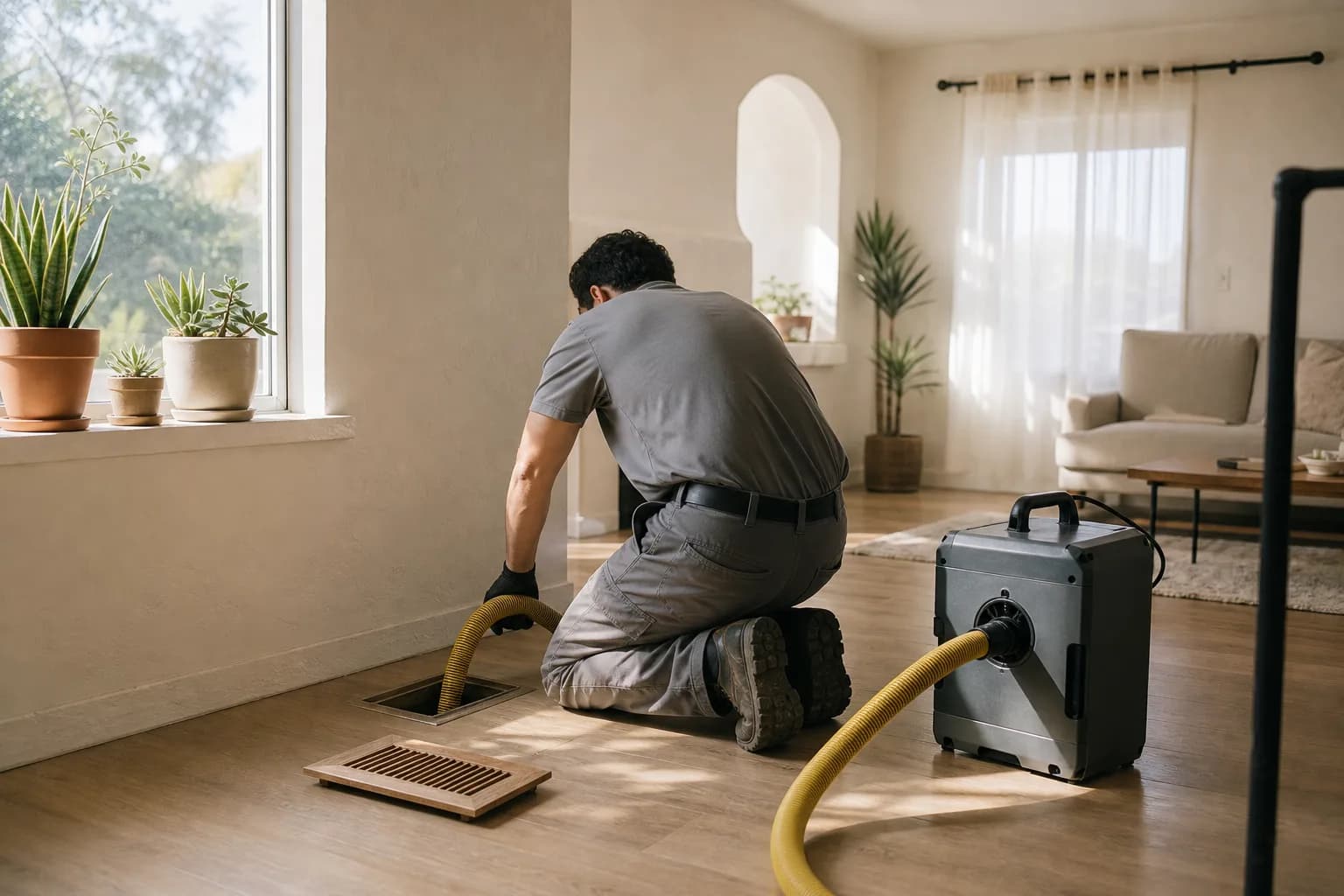
Negative air is the core of a real cleaning. We connect a truck mount vacuum (or a high-powered portable unit) to the system near the air handler and hold the duct network under suction. Then we seal off the registers and work each run with brush agitation or an air whip. The dust we knock loose gets pulled toward the vacuum and out of the house, not into your living room.
NADCA, the National Air Duct Cleaners Association, builds its ACR standard around this kind of source removal, with the system under negative pressure while it's cleaned. It's the method that actually takes debris out.
Doing it right costs a company real money: the vacuum, the fuel and engine hours to run it, long runs of large-diameter hose, setup and teardown time, and a crew trained to agitate each run without tearing up flex duct.
The cheap alternative is a shop vac at each register, or compressed air blown through the ducts with nothing pulling on the other end. A shop vac only reaches the first foot or two. Blowing without suction can push dust deeper into the system, or out of other registers and into the house.
Three questions worth asking on the phone: What vacuum do you use, and where does it connect? Do you clean every run, supplies and returns? Do you seal the registers while you work?
Attic access, crawlspaces, and hard-to-reach ducts
Most San Diego homes built in the last few decades have flex duct running through the attic. Older places in Clairemont and North Park are more likely to have metal ducts in a crawlspace, and a few have ducts under the slab. Each one changes the job. In older houses we also sometimes find duct wrap or insulation of unknown age. If something looks like old, brittle material, a good tech stops and tells you rather than scrubbing through it.
Attics slow things down. Hatches can be tight. Blown insulation hides the ducts and gets stirred up when you move. In East County and inland North County, summer attic heat can make afternoon work unsafe, so crews start early or take breaks. None of that shows up in square footage, but all of it shows up in time.
Hard access means more hours, more care, and sometimes a second tech in the attic or crawlspace. Flex duct is fragile. The inner liner can tear if a brush is forced through a tight bend or a tech steps wrong. Going slow is how you avoid damage.
If the unit is on a roof or in a shared space at a condo or HOA-managed building, check early whether you need association approval for roof access or a contractor on site. It's a scheduling problem more than a cost one, but it catches people off guard.
If a tech finds a crushed run, a disconnected duct, or insulation that's falling apart, the right move is to stop and show you, with photos if you can't get up there. Cleaning around a disconnected duct is wasted money. It's been dumping conditioned air into the attic and pulling attic dust back in.
Things that help the crew and can shorten the job: clear the area under the attic hatch and around the air handler, move stored boxes off the decking near the ducts, make sure a garage or closet unit is reachable, put pets away, and save a parking spot near the door for the hoses.
Tech tip: Before anyone shows up, pull a return grille and shoot a phone photo up into the duct with the flash on. A gray furry coat means there's real work to do. Mostly clean metal or liner means you've learned something before paying for anything.
Sanitizing, sealing, and other add-ons: which are worth paying for?
Add-ons are where quotes grow fastest. Here's how we see the common ones:
| Add-on | When it makes sense | When to skip it |
|---|---|---|
| Sanitizing / antimicrobial | Confirmed microbial growth, or after water damage in the ducts. Product should be labeled for HVAC use. | Routine dust with no moisture history |
| Duct sealing or repair | Leaks, disconnected joints, crushed or torn flex duct | Ducts tested or inspected as intact |
| Coil cleaning | Dirty evaporator coil visible, airflow or cooling problems | Coil already clean or recently serviced |
| Blower cleaning | Dust buildup on the blower wheel | Blower inspected and clean |
| Filter upgrade | Smoke events, pets, frequent filter loading | If the blower can't handle a higher-resistance filter |
| Dryer vent cleaning | Long runs, slow drying, lint at the exterior hood | Short, recently cleaned runs |
Be skeptical of any add-on sold with health promises. Cleaning can reduce dust and debris in the system. Nobody should tell you a fog or spray will cure allergies or eliminate every contaminant. The EPA's consumer guidance on duct cleaning ("Should You Have the Air Ducts in Your Home Cleaned?") says research hasn't shown that cleaning ducts prevents health problems, and it advises caution with chemical biocides. Read the current version yourself rather than taking our paraphrase.
Duct sealing and repair are separate from cleaning and should be priced on the actual fix. The blower and coil matter because a dirty blower wheel or coil can push dust back into freshly cleaned ducts and choke airflow. If the crew opens the blower compartment and it's clean, good.
If your system is in decent shape and you change the filter on schedule, you probably don't need most of these.
How to compare air duct cleaning quotes without getting burned
With two or three quotes side by side, check these, in this order:
- Scope: systems, vents counted, returns, trunks, plenum, blower, add-ons, each line by line
- Equipment: what vacuum will be on site, and whether they use negative air with brush or whip agitation
- Standards: whether they follow NADCA guidance
- Surprises: what they do if they find mold, damaged duct, or a failing blower, and whether they stop and show you first
- Time on site: a whole-house job done in well under an hour should make you ask what got skipped
- Paperwork: the quote on paper or email before work starts
Very low whole-house prices, numbers that only change with square footage, and "today only" pressure are all reasons to keep calling. A real company can explain every line.
Try to be home for the start or the finish. Ask whether they'll show you the vacuum hookup, the inside of a return after cleaning, and the blower compartment. A good crew shouldn't mind, though how they document it varies by company.
When you probably don't need duct cleaning yet
Not every house needs it. If your home is newer, air flows normally, you change filters on schedule, and there's no reason to suspect contamination, you can probably wait. One caveat on new construction: drywall dust and debris sometimes end up in ducts during the build, so look before assuming they're clean.
Good reasons to clean:
- After a remodel, especially drywall sanding or demolition
- Visible dust puffing from registers
- After wildfire smoke or ash events
- Signs of rodents or insects in ducts
- Water intrusion into ducts or the air handler
- Moving into a home with unknown history, including rentals and PCS moves
San Diego adds its own factors. Near the coast, marine layer humidity can add moisture risk, especially in ducts running through damp crawlspaces. Santa Ana winds and wildfire smoke can load up filters fast, and a clogged filter lets more debris through.
If you're unsure, start small. Pull the return grille, look at the filter and the blower if you can, or ask for a camera inspection. Then call two or three companies and ask each to count your supply and return vents and systems before giving you a number. We'd be glad to be one of them, but the comparison is worth doing whichever companies you pick.
Frequently asked questions
How often should I get my air ducts cleaned in San Diego?
There's no fixed schedule that fits every home. The EPA suggests cleaning when there's a reason, such as visible debris, pests, water intrusion, or after a remodel. Homes near the coast with damp crawlspaces, or inland homes hit hard by wildfire smoke, may need it sooner than a newer home with regular filter changes.
Does homeowners insurance cover air duct cleaning?
Routine cleaning usually isn't covered because it's considered maintenance. It may be included as part of a covered loss, such as fire, smoke, or water damage, depending on your policy. Call your insurer before scheduling and ask for the cleaning to be documented line by line.
Is it worth cleaning ducts after a wildfire smoke event?
If ash or soot got into the house, or the system ran while smoke was heavy outside, it's worth at least an inspection. Start by replacing the filter and looking inside a return and at the blower. If you see gray or black residue, a source-removal cleaning under negative air makes sense.
Will duct cleaning make my AC run better?
Cleaning ducts alone often won't change much if the ducts were only lightly dusty. Bigger efficiency gains usually come from a clean coil and blower, a fresh filter, and fixing leaky or disconnected duct. If airflow is weak, ask the tech to check those first.
Should I clean the ducts before or after I replace my HVAC system?
If you're keeping the old ducts, coordinate the cleaning with the install so old debris doesn't get pulled into a brand-new coil and blower. If the ducts are being replaced too, there's nothing to clean. Ask your installer to inspect the existing ducts for leaks and damage before deciding.